




Homily of Fr. Manel Gasch i Hurios, Abbot of Montserrat (November 1, 2026)
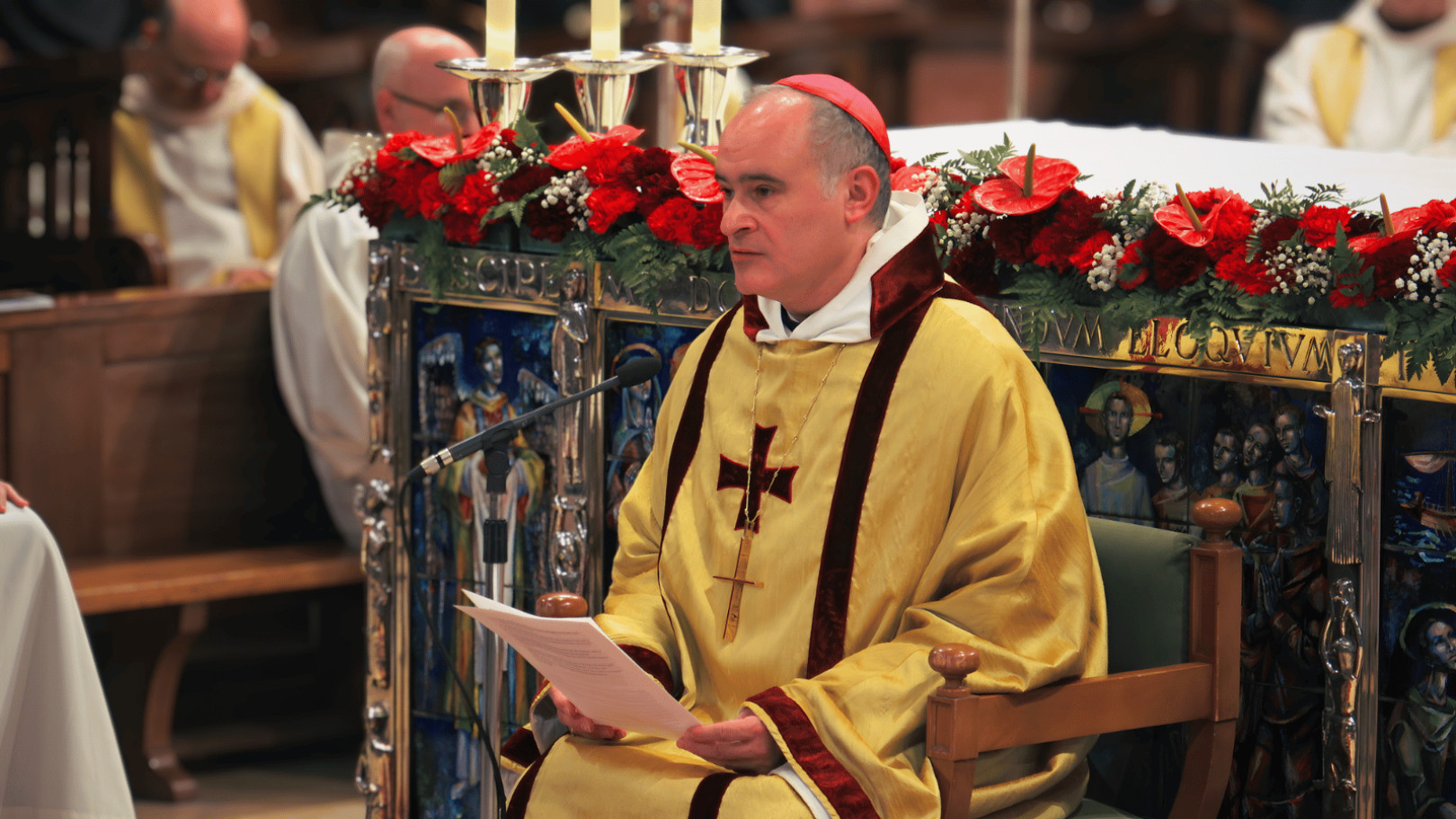
Solemnity of All Saints - Solemn Profession of Br. Josep Antoni Díaz-Pavón i Gómez
Abadía de Montserrat - EN
1 November 2026
Revelation 7:2-4.9-14 / 1 John 3:1-3 / Matthew 5:1-12a
If you take any magazine, or a Sunday supplement of the daily newspapers, and if you even failed to disable on your computers and apps that option that feeds you an automatic cascade of news and informative updates meant to distract us when we want to work, you will see something very simple... Everyone who appears there has a name, is concrete and identifiable, is famous. On some occasions, the media present them to make us desire to be like them, to have what they have, although with a deeper look we might doubt whether we would really want to be like them. But advertising is not usually profound.
The Church also has a multitude of famous people with names, surnames, and concrete lives; we call them the saints. But in today's solemnity, it offers us something very different and highly alternative: the remembrance of the anonymous,elevating this remembrance to a solemnity superior to that of almost any other named and known saint!
We truly would like to resemble all of them as Christians. Why?
To all of them, the reading of the Apocalypse places them in a vision of heaven, of God's own dimension! It is where we would like to arrive!
The Bible contains narratives that demonstrate a great capacity for imagination. The culture of the Jews born from it knows how to tell stories.
In this art of storytelling, John, identified as the author of the Apocalypse, says "I saw..." and writes inspired by the Spirit,transmitting these accounts that are the Word of God for us. John invites us to see with him—a way of seeing that is not realistic like how I see you now, but rather combines faith and imagination. We believe in this other dimension proper to God, and therefore we imagine it, speak of it, and write about it.
The Book of Revelation has imagination to spare!
The scene we heard in the first reading is dynamic and tells us who is in heaven and what they are doing there. From a first moment when, despite being many—144,000—it seemed they were counted, we have passed to the innumerable,diverse, anonymous multitude. That is why this reading fits today's solemnity. It is as if on a newspaper page we found a photograph with many people and nothing else. The protagonists are them, for no other reason than simply being there. I said anonymous, and that is not entirely true. They all have a name. Not being publicly known does not mean being someone unimportant or nameless.
Here lies the core of today's solemnity. Those who are not famous, those who do not pass into history, are also important.
This multitude stands before God. It seems their final and definitive mission is none other than to contemplate and praise Him.
One of the reasons for wearing white in the celebration is to reproduce this scene from the Apocalypse. The choirboys and the chapel choir will sing it in the offertory text by Tomás Luis de Victoria, which is not part of today's readings but captures its spirit: Amicti stolis albis, clothed in white, sequuntur agnum quo cumque ierit, they follow the Lamb wherever He goes. We do not carry palms in our hands, but we are a multitude singing the praise of God here on earth,and we want to be counted among that multitude that will one day become part of the innumerable choir praising God in heaven.
Yet they all arrived there from the great tribulation. Not even the selection of the chosen ones forgets that one must pass through a reality that never reproduces a scene of songs and praise, but rather of toil—of "washing their robes in Jesus Christ."
This, very simply, is the Christian life, which never loses sight of the reality of the world or the horizon of God. The Beatitudes of the Gospel fit perfectly here, but I will not dwell on them.
We monks, because of the time we dedicate daily to the liturgy, would like to keep in our minds and hearts this scene from the Book of Revelation where the multitude coming from the tribulation, cleansed and clothed in white, praises the Lord.
With our example, we would like to be, as we said in the psalm, "those who come to see Your face, Lord."
Today, in this Eucharist, we will pray that God corresponds to this purpose of brother Josep Antoni: to live facing Him.You have done this and learned it throughout all your years of discernment in our community. Your commitment is tied to Montserrat, just as any Benedictine monk is bound to his monastery by stability.
The very psalm that served for all the saints today captures your desire and the simple conditions for making it effective:
Who may ascend the mountain of the Lord?
Who may stand in His holy place?
The one whose hands are clean and heart is pure,
Who does not put their trust in false gods.
The yearning to go and live on the mountain where God resides, in this combination of reality, faith, and imagination, is the light that makes us run to encounter Jesus Christ, as you tell us in today's memorial, placing nothing before Him.
It is worth listening attentively to the prayer of consecration of a monk that we will now pray. It is a synthesis of how our baptized vocation finds a path in the following of Saint Benedict: on the one hand, being deeply attentive to your environment (being patient in enduring insults, solicitous in serving brothers, humane to those who suffer); but also filled with a sense of God (being firm in faith, constant in prayer, desiring eternal life with all spiritual longing). Wanting to be part of the innumerable multitude who will sing before God's throne.
In a word, as we will say at the end of the celebration in the solemn blessing:
May the charity of God make you, in the family gathered in His name, an image of the love of Jesus Christ.
In our weakness and imperfection, we monks are here to continue bearing witness to faith in the existence of God and His work in humanity, in the midst of the world.
We will also pray that God helps us conform our lives to the doctrine of the Gospel with the implications that this simple commitment entails, in a world where the power of evil is also present everywhere.
God is the center and inspirer of everything. He saves. Only through Him does every Eucharist in which we make Jesus Christ present—and with Him, the whole Church of heaven—have meaning. Without Him, there are no saints, no monks,and everything we do would make no sense. May God, therefore, be our primary witness.
Tags
Homilies Now on home page
El més llegit