



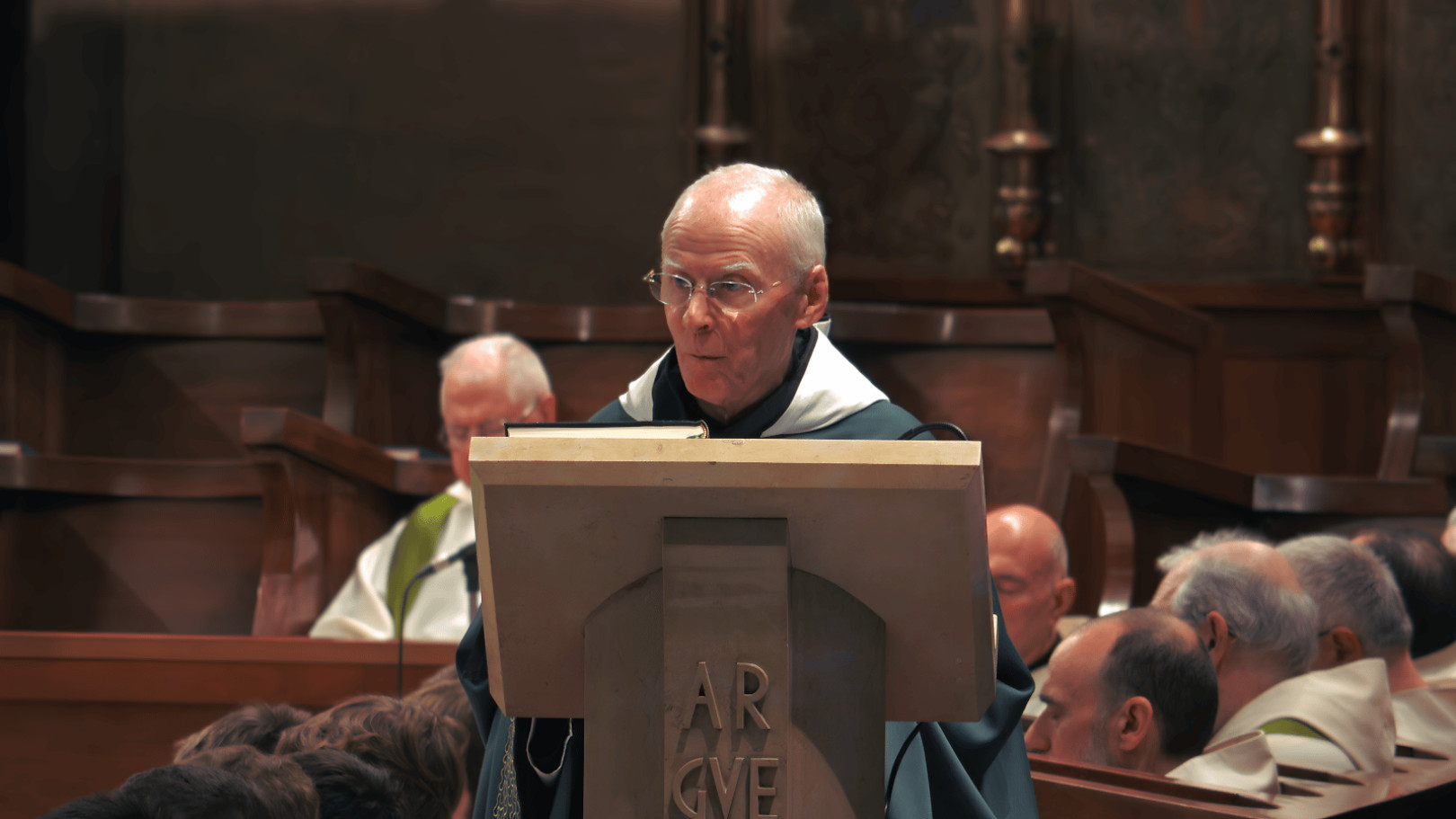
Homily by Fr. Josep Miquel Bausset, monk of Montserrat (November 15, 2026)
33rd Sunday in Ordinary Time (A)
16 November 2026
Proverbs 31:10-13.19-20.30-31 / 1 Thessalonians 5:1-6 / Matthew 25:14-30
There are those who believe that Christianity has contributed to fostering a conservative mentality in society, which favors the maintenance of the established order and is an obstacle to the progress of humanity. Often, we believers are seen as immobilized, conservative, even fundamentalist people, opposed (as they say) to innovations and changes, whether social,scientific, or of any other kind. And sometimes those who view us this way are right. One need only recall the attitude of many bishops during the nefarious forty years of National Catholicism, or the affinity, just a few days ago, of some North American bishops with the president of that country, in the Oval Office of the White House. And yet, the message of the Kingdom contains a strong charge of change and novelty. We see this in the Gospel that has been proclaimed (Mt 25:14-30). Jesus praises those two men who traded with what had been entrusted to them (surely they did not put it into a vulture fund) and, on the contrary, rebukes the "wicked, lazy servant," who merely hid the talent he had received.
In light of today's Gospel, the Church cannot remain immobile, closed in on itself like a ghetto, on the defensive, hiding what it has received like the wicked, lazy servant; rather, it must open new paths and broaden new horizons. We need a Church that goes forth, free and liberating, pilgrim, synodal. And to truly be so, "the Church," as Fr. Matabosch said last Sunday, still "lacks boldness and creativity and needs to be more open to the signs of the times" (La Vanguardia,November 8, 2026).
The Church must always (including before an electoral process) act in a non-partisan, yet non-neutral manner, because as Bishop Desmond Tutu said, "if you are neutral in situations of injustice, you have chosen the side of the oppressor." And for this reason, this South African bishop added further: "The Jesus I worship is a Jesus who was always on the side of those who were treated unjustly and got into trouble precisely because of this." Pope Francis, too, in the Italian city of Campobasso (July 5, 2014), said: "God is not neutral. He is on the side of the most fragile, discriminated, and oppressed people."
Today, the Church cannot take shelter in a false neutrality, nor look the other way, but must courageously denounce so many absurdities, injustices, and violations of human rights. This is what the German bishops did a year ago, explicitly distancing themselves from a far-right party, which they described as unelectable for a Christian (Religión Digital,February 1, 2025). The German bishops stated that participation in the AfD was an anti-Christian attitude and therefore affirmed that a Christian could not vote for this party. And just a few days ago, Catholic Action of the Canary Islands asked us not to give our vote to those organizations that criminalize immigrants (Religión Digital, November 12, 2026).
The Church of Jesus cannot be a neutral Church, and we Christians cannot close our eyes to the problems of the people.Because if we look the other way, if we are insensitive to the problems of the most disadvantaged, the Church will end up becoming "a stronghold of the far right" (Rafael Narbona, RD, October 25, 2026).
The Church must denounce hate speech, which is anti-Christian, speeches against our language, and xenophobic speeches against immigrants simply because they are poor. That is why the reflection by the Bishop of Sant Feliu de Llobregat,"Ears to the Encampments," was such a joy, where our shepherd denounces the difficulty many people face in accessing housing. "Something is not working," says Bishop Xabier, "when a house is a business and a financial asset rather than a home, or when a migrant minor is seen first as a threat rather than a child" (Flama, October 5, 2026).
Today's Gospel, sisters and brothers, invites us to walk, not to remain immobile and closed in on ourselves, not to hide the talents received, but to move forward without fear and put ourselves in the shoes of those who suffer, to have an "open faith," as Jordi López Camps has said, "in dialogue with the world, that confronts the problems society faces, and not an epidermal faith or a merely sentimental Christianity" (El Punt-Avui, November 7, 2026). The Gospel asks us to draw near to others, as Bishop Xabier Gómez tells us, "and listen to names and stories, and turn compassion or indignation into just policies."
May it be that on this World Day of the Poor, and under the guidance of Pope Leo, the Social Doctrine of the Church becomes the transformative force that makes it possible to improve the lives of those who need us and halt social inequalities and unbridled capitalism, which makes the rich ever richer and the poor ever poorer.
Tags
Homilies Now on home page
16 July 2026
El més llegit