



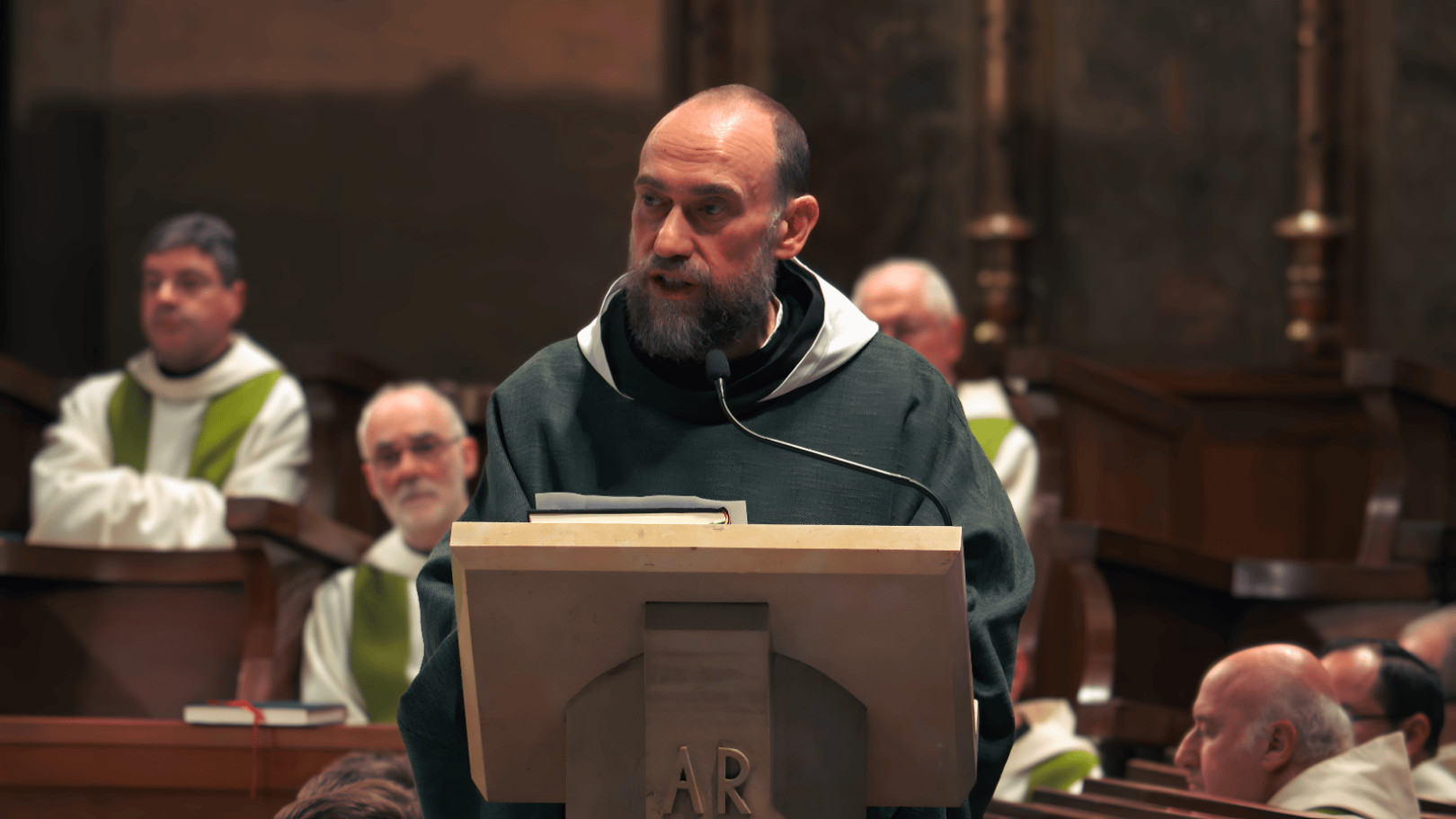
Homily by Fr. Efrem de Montellà, monk of Montserrat (November 8, 2026)
32nd Sunday in Ordinary Time (A)
Abadía de Montserrat - EN
9 November 2026
Wisdom 6:12-16 / 1 Thessalonians 4:13-18 / Matthew 25:1-23
Last week we celebrated two feasts that invited us to think about the afterlife. On the one hand, All Saints' Day invited us to contemplate the glory of heaven already enjoyed by the saints and to which we are all called; and on the other hand, the Commemoration of All Faithful Departed helped us reflect on death, that passage we must all make one day. We are at the end of the liturgical year, and during these remaining days until Advent, the liturgy proposes readings that help us delve into the mystery of death and resurrection. Such is the case with today's readings, which aim to help us understand how we must prepare for our definitive encounter with the Lord.
Jesus spoke to us of ten young women who awaited the arrival of the bridegroom to accompany him to the wedding feast.Five were wise and five were foolish. All of them carried lamps, but only the wise ones had provided themselves with oil to keep them burning if the bridegroom delayed his arrival. And indeed, the bridegroom made them wait, to the point that all of them fell asleep. This slumber of all ten young women is an evocation of death, that moment through which we all must pass. The faith of the Church teaches us that, upon dying, each person appears before God in the particular judgment and that, until the final resurrection arrives, the soul continues living separated from the body. Only when Christ returns will our bodies be resurrected transformed, and the human being, body and soul, be restored to the fullness of life. And this definitive encounter with the Lord, this entrance into the life He has promised us, is what today's parable helps us contemplate. When the bridegroom arrived, all the young women woke up, but not all were equally prepared to enter the feast. The wise ones had oil to keep their lamps burning; the foolish ones, on the other hand, realized they did not have enough. Jesus makes us see that the definitive encounter with the Lord is not a reality we can live passively, as if everything were to happen automatically, independently of our response. God offers us the gift of His life, but He wants us to be involved as well: we are called to prepare ourselves to welcome Him. And the oil we need to be prepared is everything that, throughout life, helps us recognize the Lord and love Him. Therefore, we must learn to live in His presence so that when our hour arrives, we are ready to receive the gift of His life. And today's parable reminded us that the way we live now matters for the encounter that awaits us.
Yet we do not need to die to experience the moment of encounter with the Lord. Here, in the liturgical celebration, when we gather around the risen Christ, we already live a foretaste, we already participate in some way in that encounter which one day will be definitive. The voice of the Lord that will one day call us to eternal life we have already heard today,listening to His Word in the readings. And the first reading, from the Book of Wisdom, helped us understand the attitude we must have: "Wisdom is radiant and never fades, and she is easily discerned by those who love her, and is found by those who seek her." To be wise means to live with one's heart oriented toward God, seeking Him and learning to recognize His presence in our lives. It is the wisdom we saw reflected in the young women who had prepared for the bridegroom's arrival. And Saint Paul, in the second reading, reminded us of the foundation of our hope: Jesus Christ died and rose again, and we too shall rise with Him. Therefore, death does not have the final word. This hope is what we celebrate every Sunday in the Eucharist, which is an anticipation of the definitive encounter with the Lord and of the banquet of eternal life. Here we listen to His voice, the voice of the bridegroom; here He Himself comes to meet us,speaks to us through His Word, and nourishes us with His Body. And here we are shown how to provide ourselves with oil for our lamp. Every celebration is thus a foretaste of that life God promises us, and an indication of how we must walk the path to reach it.
Therefore, today we can ask ourselves whether we have enough oil to keep the lamp of our life burning. It is not a matter of living obsessed with death or with fear of what awaits us, but of preparing ourselves for the encounter with the Lord.This means providing ourselves with the oil of faith and prayer, keeping ourselves attentive to His Word, but also, and very specially, providing ourselves with the oil of love. Because the way we treat others matters; the deeds we perform in a spirit of service matter; our capacity to forgive and the generosity with which we give ourselves to those beside us, all of this matters. Not because we earn the gift of eternal life through our own works, which is always a gift from God, but because that is how we welcome Him and dispose ourselves to live in communion with Him. It is these attitudes and these works that conform our life to that of Christ and make His light shine within us. We cannot leave this preparation for the very last moment, because it is today that the Lord comes out to meet us, and it is today that we can already learn to welcome Him. Let us ask Him, then, to grant us the wisdom to live with our hearts set on Him and to help us always keep the lamp of faith and love burning, so that when our hour arrives, we may enter with Him into the banquet of eternal life.
Tags
Homilies Now on home page
16 July 2026
El més llegit