




Homily by Fr. Jordi Castanyer, monk of Montserrat (October 11, 2026)
28th Sunday in Ordinary Time (Cycle A)
Abadía de Montserrat - EN
11 October de 2026
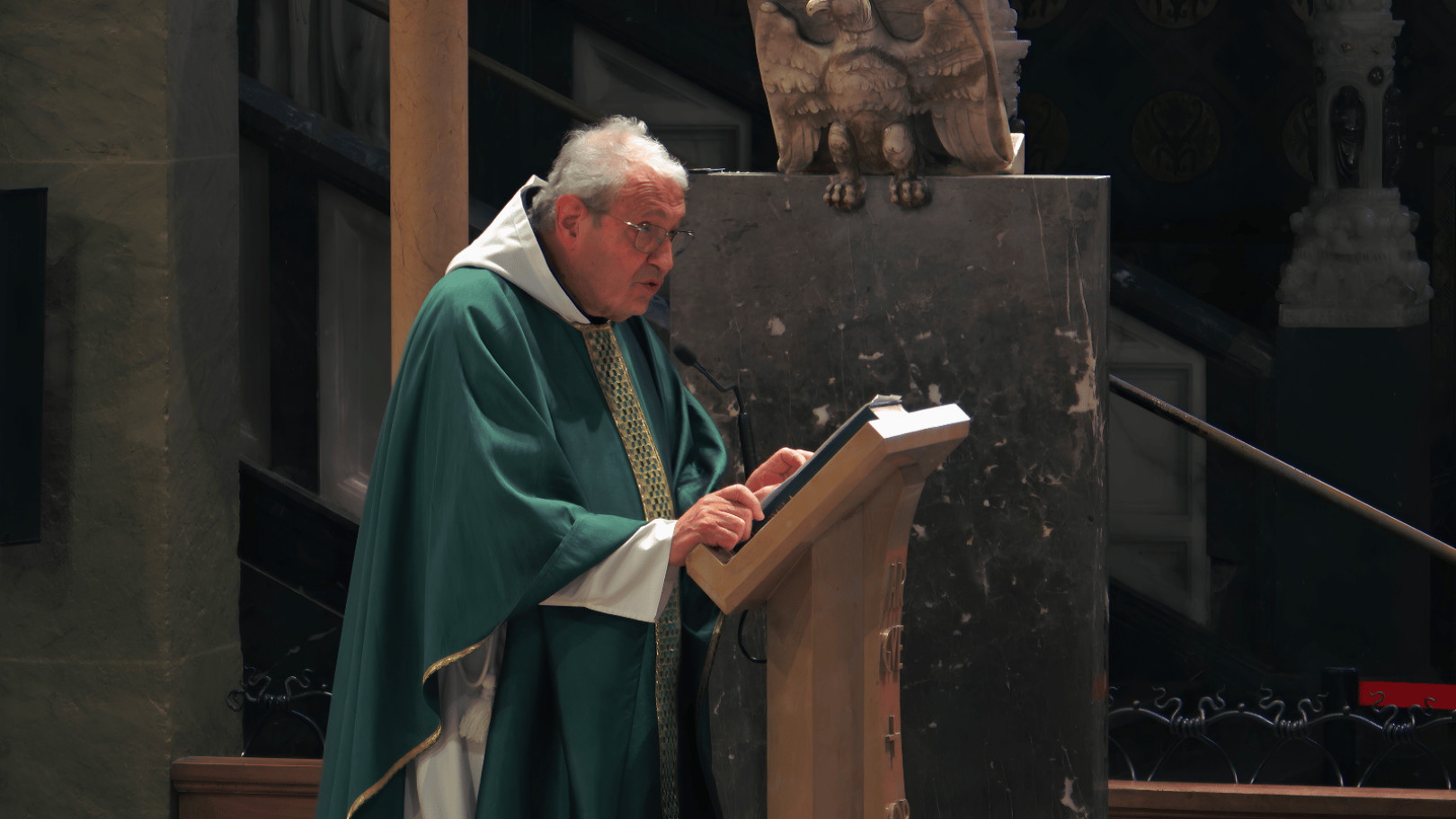
Isaiah 25:6-9 / Philippians 4:12-14.19-20 / Matthew 22:1-14
Dear friends, I will begin with two introductory remarks before the homily proper.
Since many of you were probably surprised by the ending of the Gospel we have just heard—this king who invites everyone to the banquet, good and bad alike, but then strongly reprimands someone who is not properly dressed—let me tell you that we have heard not one but two parables: the one about the guests at a wedding banquet, and secondly, the one about the garment that must be worn if we accept the invitation; this second one is an addition found only in the Gospel of Saint Matthew. I will refer to it later.
And a second preliminary remark that applies to all the parables Jesus tells us. If we listen to them as though we were seated in the stalls of a theatre, simply watching what unfolds on the stage, you can be sure we will capture neither their meaning nor, above all, the provocative charge they contain and which is intended by Jesus. We must place ourselves on the stage, in the shoes of every character.
Jesus, as we have heard, presents today's parables to the chief priests and the elders of the people. Wise people, important people, people who surely keep the law, who preach and impose the rules that must be followed, but who also, surely, look down on the ignorant and those considered sinners. Satisfied with themselves, busy with a thousand often superfluous things, they pass by what is most important: justice, goodness, mercy... much like those who pass by even after seeing a wounded person asking for help by the roadside. God invites them to a banquet, to sit at table with Him, to enjoy His love. But they refuse; they have more important things to do. It could be us, brothers and sisters, even though we do not consider ourselves notables of the people nor—for the vast majority—chief priests, who, proud of our belonging to the Catholic Church, are unaware that we are permanently invited to communion with God Himself; we are there, but we do not enjoy it, much like the older brother in the well-known parable of the prodigal son: he is in his father's house and does not take joy in it. And not only do we fail to enjoy it, but we live drawn to a thousand things and refusing God's many invitations. "Will you come?" He asks us; "I have everything ready, for you and for everyone. Will you share in my joy?" But we refuse His food, His drink, which is Himself, and we chase after broken cisterns and food that does not satisfy.
The parable tells us that the king persistently sends his servants to call the invited guests. Now let us put ourselves in the shoes of these servants. God sends us; you, that person over there, and myself, all of us who are here now and all of you united with us from wherever you may be, we are all sent; the Church is sent. Where? To the world, and by the world we mean every place where we live, where we work, far or near. We must be missionaries, through our word and our life. God, who sends us, excludes no one; let us not exclude anyone either. Let us be bearers of this good news: God welcomes everyone—yes, also and above all those who feel excluded by the well-to-do, by the meticulous observers of the law.
And now comes the wedding garment, the other parable that Matthew adds to the previous one. Jesus tells us that it is not enough simply to be invited to the banquet; the invitation, which we never deserve, comes from the goodness of God; it is His doing, born of His love. We accept it, agreed. But we must make ourselves at least somewhat worthy of it, consistent with the invitation we have freely accepted. The wedding garment is charity, justice, goodness, forgiveness. Because, to put it perhaps too bluntly, it is not enough to come to Mass, to sit at table with the Lord; consistency of life is required. As Saint Paul would say, we must take off the old garment and clothe ourselves with Jesus Christ Himself, the wedding garment.
Brothers and sisters, we are at table, we have accepted the invitation the Lord has extended to us to sit with Him, to listen to His word, and to eat the food that is Himself. We do not deserve it; we are not worthy. He makes us worthy. But let us look at what garment we are wearing; let us be consistent.
Dear friends, I will begin with two introductory remarks before the homily proper.
Since many of you were probably surprised by the ending of the Gospel we have just heard—this king who invites everyone to the banquet, good and bad alike, but then strongly reprimands someone who is not properly dressed—let me tell you that we have heard not one but two parables: the one about the guests at a wedding banquet, and secondly, the one about the garment that must be worn if we accept the invitation; this second one is an addition found only in the Gospel of Saint Matthew. I will refer to it later.
And a second preliminary remark that applies to all the parables Jesus tells us. If we listen to them as though we were seated in the stalls of a theatre, simply watching what unfolds on the stage, you can be sure we will capture neither their meaning nor, above all, the provocative charge they contain and which is intended by Jesus. We must place ourselves on the stage, in the shoes of every character.
Jesus, as we have heard, presents today's parables to the chief priests and the elders of the people. Wise people, important people, people who surely keep the law, who preach and impose the rules that must be followed, but who also, surely, look down on the ignorant and those considered sinners. Satisfied with themselves, busy with a thousand often superfluous things, they pass by what is most important: justice, goodness, mercy... much like those who pass by even after seeing a wounded person asking for help by the roadside. God invites them to a banquet, to sit at table with Him, to enjoy His love. But they refuse; they have more important things to do. It could be us, brothers and sisters, even though we do not consider ourselves notables of the people nor—for the vast majority—chief priests, who, proud of our belonging to the Catholic Church, are unaware that we are permanently invited to communion with God Himself; we are there, but we do not enjoy it, much like the older brother in the well-known parable of the prodigal son: he is in his father's house and does not take joy in it. And not only do we fail to enjoy it, but we live drawn to a thousand things and refusing God's many invitations. "Will you come?" He asks us; "I have everything ready, for you and for everyone. Will you share in my joy?" But we refuse His food, His drink, which is Himself, and we chase after broken cisterns and food that does not satisfy.
The parable tells us that the king persistently sends his servants to call the invited guests. Now let us put ourselves in the shoes of these servants. God sends us; you, that person over there, and myself, all of us who are here now and all of you united with us from wherever you may be, we are all sent; the Church is sent. Where? To the world, and by the world we mean every place where we live, where we work, far or near. We must be missionaries, through our word and our life. God, who sends us, excludes no one; let us not exclude anyone either. Let us be bearers of this good news: God welcomes everyone—yes, also and above all those who feel excluded by the well-to-do, by the meticulous observers of the law.
And now comes the wedding garment, the other parable that Matthew adds to the previous one. Jesus tells us that it is not enough simply to be invited to the banquet; the invitation, which we never deserve, comes from the goodness of God; it is His doing, born of His love. We accept it, agreed. But we must make ourselves at least somewhat worthy of it, consistent with the invitation we have freely accepted. The wedding garment is charity, justice, goodness, forgiveness. Because, to put it perhaps too bluntly, it is not enough to come to Mass, to sit at table with the Lord; consistency of life is required. As Saint Paul would say, we must take off the old garment and clothe ourselves with Jesus Christ Himself, the wedding garment.
Brothers and sisters, we are at table, we have accepted the invitation the Lord has extended to us to sit with Him, to listen to His word, and to eat the food that is Himself. We do not deserve it; we are not worthy. He makes us worthy. But let us look at what garment we are wearing; let us be consistent.
Tags
Homilies Now on home page
14 october de 2026
16 july de 2026
El més llegit