




Abadia de Montserrat
.jpg)
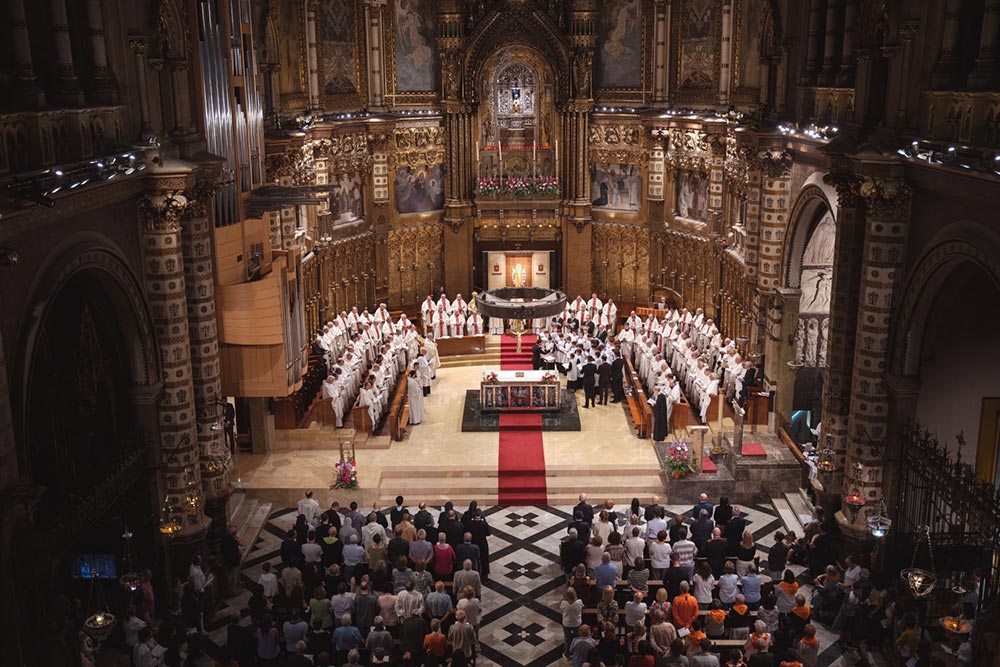

Lord, thank you for opening the doors for me to communion with You and with my brothers and sisters.
Saint Matthew, apostle
Saint Matthew is one of the Twelve apostles. According to the Gospel, he was a tax collector serving the Romans in Capernaum until Jesus called him to follow him, whereupon he left his trade to join the Twelve. Matthew hosted a great banquet for Jesus, prompting criticism from the scribes and Pharisees because he ate with tax collectors and sinners. Jesus answered them: "It is not the healthy who need a doctor, but the sick."
Ancient Christian tradition attributes to him the composition of a gospel intended especially for Christians of Jewish origin. As early as the 2nd century, Saint Irenaeus of Lyons affirmed that Matthew had published a written work among the Hebrews in their own language. His Gospel presents Jesus as the Messiah foretold by the Scriptures of Israel and emphasizes his teaching. In the tetramorph, Matthew is represented by a winged man because his gospel opens with the human genealogy of Jesus.
Dedication of the Cathedral of Girona
The Christian community of Girona already had a bishop by the beginning of the 5th century. Following the Muslim incursions, the Girona see found protection under Charlemagne and was integrated into the Carolingian organization. Later, the Romanesque cathedral was rebuilt and consecrated on September 21, 1038. At the beginning of the 14th century, a major Gothic expansion began—starting with the apse—and lasted for over three centuries. When the new structure was completed, a new consecration was deemed unnecessary, so the 1038 date was retained. The Cathedral of Girona, dedicated to Saint Mary, is especially known for its vast Gothic nave, one of the most monumental in European medieval architecture.
Saint Jonah, Old Testament prophet
The biblical book bearing his name relates how this prophet is sent by God to preach repentance to the people of Nineveh, a pagan city that oppressed Israel. Jonah, however, flees from his mission and sets sail in the opposite direction. During the voyage, a storm threatens the ship, and Jonah ends up thrown into the sea, where he is swallowed by a great fish and remains inside its belly for three days and three nights. God rescues him, and Jonah finally goes to Nineveh, where his preaching leads to the city's conversion. Yet Jonah cannot accept that God would forgive the Ninevites and becomes displeased by His mercy. The book concludes by showing him that God also loves those whom Jonah regarded as enemies, and that His desire for salvation extends to all nations.
Deborah, Old Testament prophetess and judge
Deborah, a Hebrew name meaning "bee," is introduced in the Book of Judges as a prophetess and judge of Israel—the only woman to hold this office. Seated under the palm tree that bears her name, she administered justice and conveyed God's directives to the people. At her command, Barak assembled Israel's army against the Canaanites led by Sisera. The victory culminated in Sisera's death at the hands of Jael, and Deborah and Barak celebrated the triumph with a song of victory.
The Song of Deborah, preserved in the Book of Judges, is considered one of the oldest poems in the Bible and serves as a valuable record of Israel's early history in Canaan. Her figure was recalled with admiration by several Church Fathers, who saw in her a testament to the courage and capacity of women.
The line from the song, "The mountains flowed before you, Lord," gave its name to the Deborah number, a physical concept describing the degree of fluidity of a material relative to the time scale of observation.
Agenda
Lorem ipsum dolor sit amet consectetur adipiscing elit. Quisque faucibus ex sapien vitae pellentesque sem placerat.
Horaris
Lorem ipsum dolor sit amet consectetur adipiscing elit. Quisque faucibus ex sapien vitae pellentesque sem placerat.
Ofrenes
Lorem ipsum dolor sit amet consectetur adipiscing elit. Quisque faucibus ex sapien vitae pellentesque sem placerat.
Notícies
Segueix les novetats i les notícies més destacades de l’Abadia de Montserrat: comunitat, cultura, opinió, l’Escolania de Montserrat i el contingut de l’actualitat més montserratina!
Reserves
Lorem ipsum dolor sit amet consectetur adipiscing elit. Quisque faucibus ex sapien vitae pellentesque sem placerat.
Els valors benedictins de Montserrat
El lema Ora, Lege, Labora, Rege te ipsum, In Communitate es pot començar a llegir de de la seva base per anar-ne desgranant els valors que conté fins a arribar al cim al que no és altre que Déu.
La pregària
La pregària és el centre del dia a dia dels monjos. A través de l'Ofici Diví i la Missa conventual, la comunitat s'uneix per trobar-se amb Déu i amb els germans. Preguem per recordar que la vida és més gran que nosaltres i trobar sentit a allò que fem.