




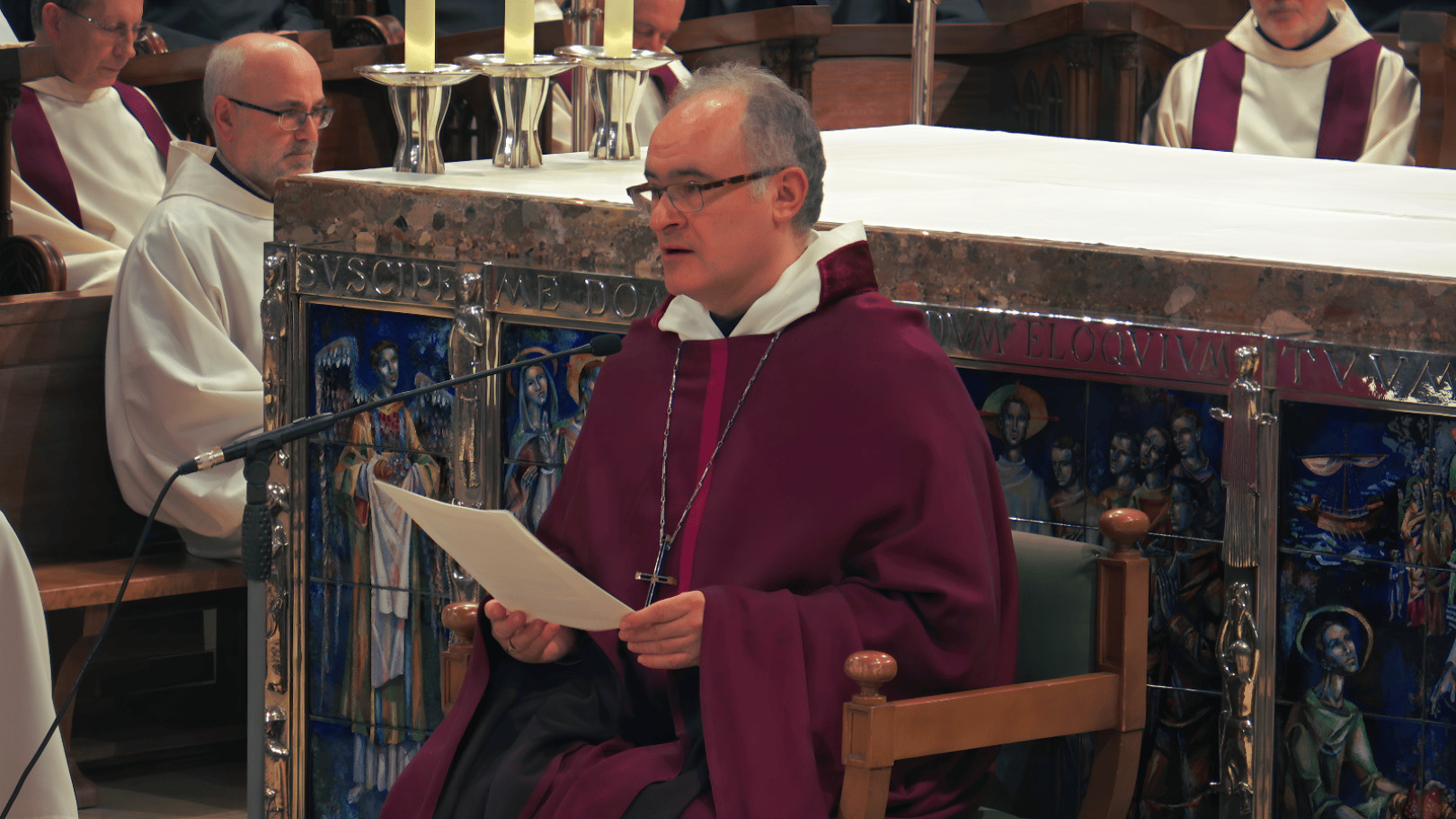
Homily by Fr. Manel Gasch i Hurios, Abbot of Montserrat (November 24, 2026)
Funeral Mass for the soul of Fr. Bonifaci M. Tordera, monk of Montserrat
Abadía de Montserrat - EN
24 November 2026
Job 19:1, 23-27a / 2 Corinthians 4:14–5:1 / Luke 12:35-40
Death never fails. It is a reality as human as life itself. Perhaps someone like Fr. Bonifaci himself—who reached ninety-four in very good health and only ten days ago was sharing everyday life with us as normal—can deceive us for a few moments, as if dying did not apply to some people, yet it is merely a matter of patience.
Our Christian faith holds death as one of the most important moments. Throughout our entire lives, if God grants us the grace to believe, we are at heart anticipating a reality of heaven that we will only find at the end. It is that day, the dies illa, which this very week we are remembering by taking as our hymn the text of the sequence from the Mass for the Dead, made so famous by the film Amadeus. Let us remember that we are at the end of the liturgical year.
The death of someone loved makes the reality of this day of death very concrete, a day in which so many things happen.
The richness of a believing existence lies in always referring back to the truth that Revelation and the Church set before us. The trouble would be if we thought this proposal of life were heading toward an insurmountable judgment and lived our faith in anguish. God is demanding, yet He is so in love.
Today's readings have spoken to us a great deal about how to live our Christian life with full awareness under the expectation of this final moment of death, which will be the moment of encounter with the Lord and therefore will culminate not only our physical existence, but also our spiritual one.
The Gospel exhorted us to live in constant watchfulness, ready to serve. Not knowing the hour of our death must not lead us, as Christians, to indifference or to putting everything off until tomorrow, but rather to the demand of love. Monastic life identifies deeply with this living in expectation, which is proper to faith. The Rule of Saint Benedict, even though it contains so many verses devoted to day-to-day life in so many matters, never loses sight of the fact that we are journeying toward God.
The reading from the Book of Job—a man subjected to all kinds of misfortunes and an example of what I am trying to say about how faith passes through life—tells us that in this final moment he will know that his Redeemer lives and will testify on his behalf: "I shall behold God. I myself, no other." Job's confession draws us into the primary reality of faith,which is deeply individual. No one believes in our place. Vocation, too, is an individual call. In our deceased brothers we recognize this persevering response that links an entire single existence together. Those of us who were close to Fr.Bonifaci recognized it in him as well.
Death is also individual. The second letter to the Corinthians that we read spoke very clearly of the future awaiting us.
Our faith concerns itself with our physical reality, and therefore affirms the transformation of passing from the body to a building from God, assuring us that in eternity and the resurrection our personality and our physical individuality will continue, mysteriously transformed, in the final resurrection.
And naturally, death also resolves our spiritual reality. Personal continuity between life and death is one of the jewels of Christianity. Believing that we do not dissolve into nothingness, nor reincarnate into any other being, but rather that we will be who we have been, passed through the mercy of God, gives our lives a most profound meaning that makes real what the psalm says: I shall enjoy in this life and in eternal life the goodness the Lord has in store for me.
Fr. Bonifaci lived this way too, as a Christian, as a monk, and as a priest. He lived with God as his reference point from his youth. During the nearly ninety-five years of his life, he showed us that faith is something serious, radical, which at times clashes with society. When he had been in the monastery for only nine years, he answered Abbot Brasó's call to strengthen our foundation in Envigado - Medellín, where the first Benedictine community in Colombia was responsible for a school. A few years later, together with other monks who had also come from Montserrat, they decided to separate from the school and found another community in Usme, near Bogotá, which eventually moved to Guatapé, in the department of Antioquia. Out of the forty-five years he spent in Colombia—where he went with the peace of mind that after five years he could return to Montserrat—he spent forty dedicated to this second community of Usme - Guatapé,where he served as prior and novice master and where they have always loved him as a true father and founder. Upon returning to Montserrat, he continued living as a monk and assisting in various services. Despite the changes in the community of 2007 compared to that of 1962, he never became a stranger to our life.
I appreciated a remark by Abbot Humberto of Guatapé, who in the letter of condolence to the community that we received yesterday said that when he was in Guatapé, they perceived in him a very strong bond with Montserrat—which translated especially into adapting many chants into Spanish—and that when he returned to Montserrat, he never ceased to be a monk of Guatapé. Although canonically monks belong to only one monastery, in his heart Fr. Bonifaci always carried both communities, and today we feel deeply united with them.
Let us commend, then, this journey that he made among us. On the dies illa, we will all have to commend ourselves to the mercy of God, yet the very core of our faith is to proclaim that God is good and forgiving. It is in this hope that death,united with that of Jesus Christ, does not end in nothingness or in any destruction, but is the final union and communion with Him. The resurrection of Jesus of Nazareth is the hope of our resurrection and of our entrance into the eternity of heaven, where we will live with Him forever.
Tags
Homilies Now on home page
16 July 2026
Most read