



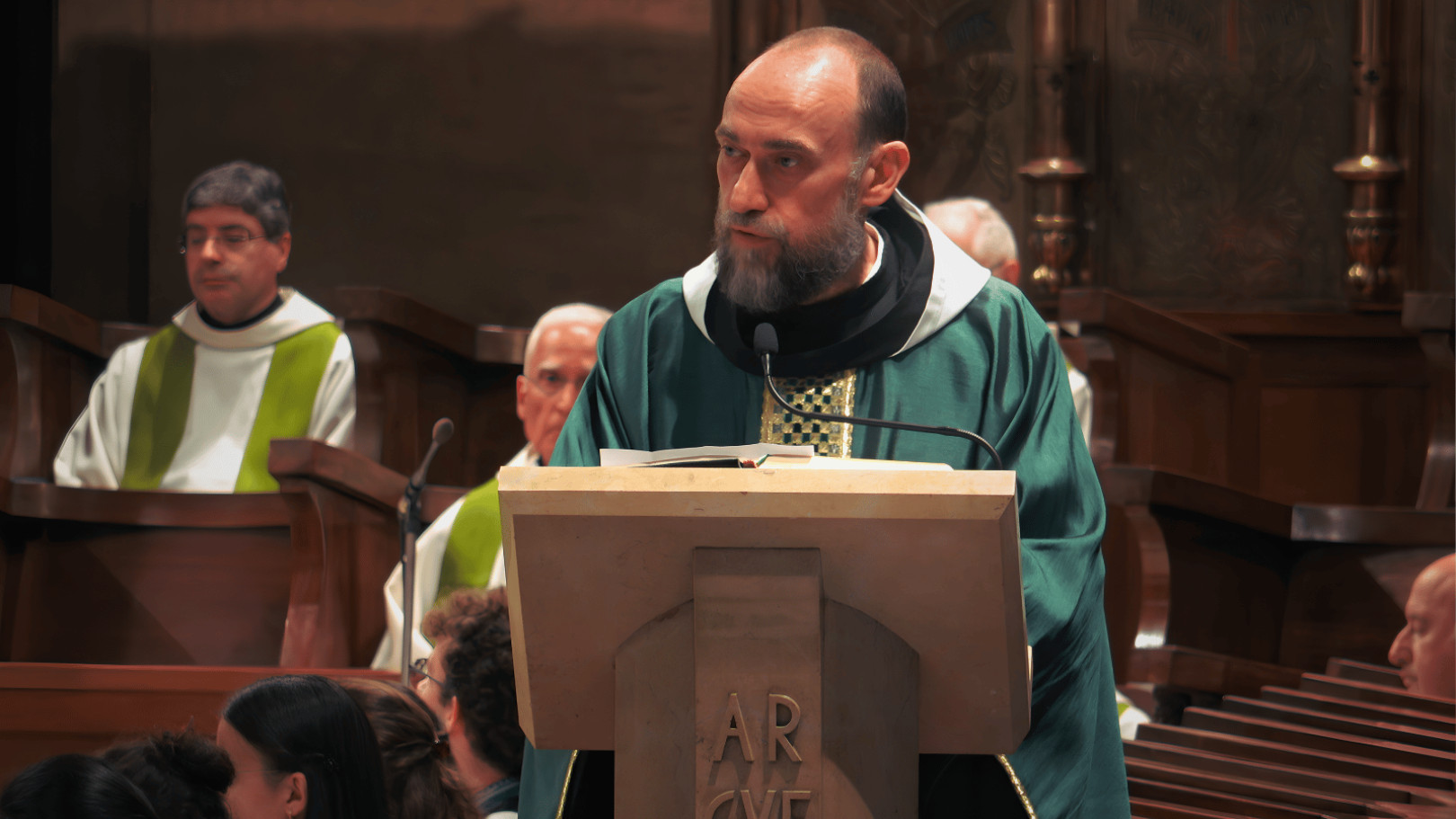
Homily of Fr. Efrem de Montellà, monk of Montserrat (September 27, 2026)
Sunday XXVI in ordinary time (A)
Abadía de Montserrat - EN
27 September de 2026
Ezequiel 18:25-28 / Filipencs 2:1-11 / Mateu 21:28-32
In the eyes of God, dear brothers and sisters, no one is defined by their past, nor can anyone consider their path at an end. Or, put another way: God does not classify people as "good" or "bad," but instead regards us all as people on a journey, traveling with the hope that it will bring us to a good end.
Consider the parable presented in today's Gospel: Jesus told it to the chief priests and elders of the people, who in his time were those who considered themselves righteous, close to God, well-versed in the Law, and convinced they had said "yes." Yet Jesus tells them that the tax collectors and prostitutes are entering the kingdom of God ahead of them—not because what they had done was right, but because they listened to John, believed his message, and repented. Looking deeper, we can see that neither son did exactly what his father had asked: one said he would not go work in the vineyard, but later repented and went; the other said "yes," but did not go. When Jesus asks which of the two did the father's will, the answer seems obvious—the first one. Yet in a strict sense, neither did. Perhaps Jesus wants us to realize that before God, not everything is settled by our initial response. There are things we say and then do not do; there are decisions we make and later change; there are times when we think we will follow one path and end up taking another. And there are also times when we have said no, that we didn't want to, that it wasn't for us... and, over time, something changes within us. This is why the first reading shares something vital to remember: if a wicked person turns away from their sin and does what is right, "they shall save their life." God does not look at us as a static photograph, as if who we have been up to this day must dictate who we will be tomorrow. God also looks at what we can still become. And that is good news. It means our past does not have the final say. A mistake does not have the final say. A chapter of our life does not either. Not even a "no" we may have given to God. As long as we are alive, there is always the possibility of a new beginning. And perhaps this applies not only to those who feel far from God. We too, who believe we have already said "yes," may need to allow ourselves to be converted anew.
This matters because it helps us understand why we are here today. The Eucharist is not a gathering of "the good," nor a celebration for those who already do everything right. It is a place where everyone—just and sinner alike, each with their own past—comes to listen to Jesus once more and allow His Word to move us from within. Conversion is not only for those who have gone down the wrong path and wish to turn back; it is also for those who think they are already on the right path and need to discover what still needs changing. Returning to the parable, it is deeply significant that the first son does not change because he is forced to, but because he repents. Something inside makes him turn back and change direction. This is precisely what we call "conversion": not simply feeling guilty for doing something wrong, but discovering that we can live differently. That is why listening to Jesus is so important: He does not come merely to tell us what to do, but to show us a new way to live. He shows us that life is not about putting ourselves at the center, defending what is ours, or seeking only our own interest. Saint Paul described this in words that are almost a portrait of Jesus: "Let each of you look not only to his own interests, but also to the interests of others," before presenting Christ, who "humbled himself" and became a servant. This is what we celebrate today: a Christ who does not remain distant, but gives Himself to us; a Christ who does not command "do this," but goes before us, showing us the way while leaving the choice to us.
So perhaps the question we can ask ourselves today is very simple: what am I doing with my life? Not just what I say. Not just what I think of myself. Not just what I would like to become. But: what am I truly doing with what I have received—with the gifts God has placed within me, with the time I have, with the people beside me, with the opportunities given to me? What am I making of all this? The Christian life does not begin when we have everything figured out; it begins when we discover that Jesus is speaking to us and we dare to listen. Perhaps today someone might realize they have long been saying "no" to something God is asking of them. Perhaps someone else realizes they have spoken many "yesses" with their lips, but have not yet begun to live them out. Perhaps someone has grown so accustomed to thinking they are fine as they are that they no longer listen to what Jesus is asking of them today. And perhaps someone simply needs to know that they can always start over. In the Father's vineyard—in our world—there is always work to be done, and there is always a place for us. We do not need to arrive with our lives completely sorted out; we only need to start walking. That is what Jesus does: He does not lock us into who we have been, but opens a path toward who we can become. And that is why He is worth listening to. When Jesus says "come," He is not asking us to stop being ourselves; He is inviting us to discover that we can be transformed. Let us pray, brothers and sisters, that today we may listen to His voice, even if we have said no to Him in the past—and that we may have the courage to take, perhaps for the very first time, that step we have not yet dared to take.
In the eyes of God, dear brothers and sisters, no one is defined by their past, nor can anyone consider their path at an end. Or, put another way: God does not classify people as "good" or "bad," but instead regards us all as people on a journey, traveling with the hope that it will bring us to a good end.
Consider the parable presented in today's Gospel: Jesus told it to the chief priests and elders of the people, who in his time were those who considered themselves righteous, close to God, well-versed in the Law, and convinced they had said "yes." Yet Jesus tells them that the tax collectors and prostitutes are entering the kingdom of God ahead of them—not because what they had done was right, but because they listened to John, believed his message, and repented. Looking deeper, we can see that neither son did exactly what his father had asked: one said he would not go work in the vineyard, but later repented and went; the other said "yes," but did not go. When Jesus asks which of the two did the father's will, the answer seems obvious—the first one. Yet in a strict sense, neither did. Perhaps Jesus wants us to realize that before God, not everything is settled by our initial response. There are things we say and then do not do; there are decisions we make and later change; there are times when we think we will follow one path and end up taking another. And there are also times when we have said no, that we didn't want to, that it wasn't for us... and, over time, something changes within us. This is why the first reading shares something vital to remember: if a wicked person turns away from their sin and does what is right, "they shall save their life." God does not look at us as a static photograph, as if who we have been up to this day must dictate who we will be tomorrow. God also looks at what we can still become. And that is good news. It means our past does not have the final say. A mistake does not have the final say. A chapter of our life does not either. Not even a "no" we may have given to God. As long as we are alive, there is always the possibility of a new beginning. And perhaps this applies not only to those who feel far from God. We too, who believe we have already said "yes," may need to allow ourselves to be converted anew.
This matters because it helps us understand why we are here today. The Eucharist is not a gathering of "the good," nor a celebration for those who already do everything right. It is a place where everyone—just and sinner alike, each with their own past—comes to listen to Jesus once more and allow His Word to move us from within. Conversion is not only for those who have gone down the wrong path and wish to turn back; it is also for those who think they are already on the right path and need to discover what still needs changing. Returning to the parable, it is deeply significant that the first son does not change because he is forced to, but because he repents. Something inside makes him turn back and change direction. This is precisely what we call "conversion": not simply feeling guilty for doing something wrong, but discovering that we can live differently. That is why listening to Jesus is so important: He does not come merely to tell us what to do, but to show us a new way to live. He shows us that life is not about putting ourselves at the center, defending what is ours, or seeking only our own interest. Saint Paul described this in words that are almost a portrait of Jesus: "Let each of you look not only to his own interests, but also to the interests of others," before presenting Christ, who "humbled himself" and became a servant. This is what we celebrate today: a Christ who does not remain distant, but gives Himself to us; a Christ who does not command "do this," but goes before us, showing us the way while leaving the choice to us.
So perhaps the question we can ask ourselves today is very simple: what am I doing with my life? Not just what I say. Not just what I think of myself. Not just what I would like to become. But: what am I truly doing with what I have received—with the gifts God has placed within me, with the time I have, with the people beside me, with the opportunities given to me? What am I making of all this? The Christian life does not begin when we have everything figured out; it begins when we discover that Jesus is speaking to us and we dare to listen. Perhaps today someone might realize they have long been saying "no" to something God is asking of them. Perhaps someone else realizes they have spoken many "yesses" with their lips, but have not yet begun to live them out. Perhaps someone has grown so accustomed to thinking they are fine as they are that they no longer listen to what Jesus is asking of them today. And perhaps someone simply needs to know that they can always start over. In the Father's vineyard—in our world—there is always work to be done, and there is always a place for us. We do not need to arrive with our lives completely sorted out; we only need to start walking. That is what Jesus does: He does not lock us into who we have been, but opens a path toward who we can become. And that is why He is worth listening to. When Jesus says "come," He is not asking us to stop being ourselves; He is inviting us to discover that we can be transformed. Let us pray, brothers and sisters, that today we may listen to His voice, even if we have said no to Him in the past—and that we may have the courage to take, perhaps for the very first time, that step we have not yet dared to take.
Tags
General Now on home page
16 july de 2026
27 september de 2026
El més llegit