



Abadia de Montserrat
Lord, may we know how to live soberly, justly, and godly.
Saint Leo I, the Great, Pope and Doctor of the Church
Born in the region of Tuscia, Italy, he became a deacon of the Church of Rome around the year 430. When Pope Sixtus III died in 440, he was elected to succeed him. His pontificate of over twenty-one years unfolded during an era marked by the invasions of barbarian peoples (such as Attila’s Huns and Genseric’s Vandals), the weakening of imperial authority in the West, and a profound social crisis. Leo thus assumed a prominent role both in the life of the Church and in the defense and care of the population of Rome: "without Christ we can do nothing, but with Him we can do all things."
One of the best-known episodes of his pontificate was his meeting with Attila, king of the Huns, in 452 near Mantua. Leo,leading a Roman delegation, persuaded Attila to abandon his invasion of Italy. Three years later, when Genseric’s Vandals entered Rome, Leo went out to meet them once again and, although unable to prevent the sacking of the city, ensured that it was not burned and that the principal basilicas were respected.
Leo was also one of the great theologians of the early Church. At the Council of Chalcedon in 451, his doctrine concerning Christ, true God and true man, was received as an expression of the apostolic faith, prompting the conciliar fathers to acclaim him: "Peter has spoken through the mouth of Leo; Leo has taught according to piety and truth." Nearly one hundred and fifty letters and numerous sermons survive, showing his ability to articulate the faith with clarity and depth. He died in Rome on November 10, 461, and was buried near the tomb of Saint Peter. He is venerated as a Doctor of the Church.
Saint Andrew Avellino, Priest
Lancelot was born in Castronuovo in 1521. After being ordained a priest around 1545, he went to further his studies in Naples and worked as a lawyer in the ecclesiastical tribunal. There he joined the congregation of regular clerics,commonly known as the Theatines, which had been founded by Saint Cajetan amid the climate of clergy renewal in the sixteenth century. He made his profession taking the name Andrew. He was a man fully dedicated to the renewal of Christian life, preaching, and spiritual direction. He carried out his pastoral work in Milan, collaborating with Saint Charles Borromeo to implement the Tridentine reforms. Later he moved to Piacenza and finally to Naples, where he died on November 10, 1608, as he was beginning Mass, saying: "I will go to the altar of God." He was canonized in 1712.
The Dedication of the Cathedral of Solsona
The Cathedral of Solsona is the former Augustinian canonical church consecrated on November 10, 1163, and later rebuilt in the Gothic style. The bishopric was created on July 19, 1593, with parishes detached from the dioceses of Urgell and Vic, at the desire of King Philip II to establish a series of dioceses near the frontier as a barrier against the penetration of the Huguenots.
Calendar
Lorem ipsum dolor sit amet consectetur adipiscing elit. Quisque faucibus ex sapien vitae pellentesque sem placerat.
Schedule
Lorem ipsum dolor sit amet consectetur adipiscing elit. Quisque faucibus ex sapien vitae pellentesque sem placerat.
Offerings
Lorem ipsum dolor sit amet consectetur adipiscing elit. Quisque faucibus ex sapien vitae pellentesque sem placerat.
News
Segueix les novetats i les notícies més destacades de l’Abadia de Montserrat: comunitat, cultura, opinió, l’Escolania de Montserrat i el contingut de l’actualitat més montserratina!
Bookings
Lorem ipsum dolor sit amet consectetur adipiscing elit. Quisque faucibus ex sapien vitae pellentesque sem placerat.
The Benedictine values of Montserrat
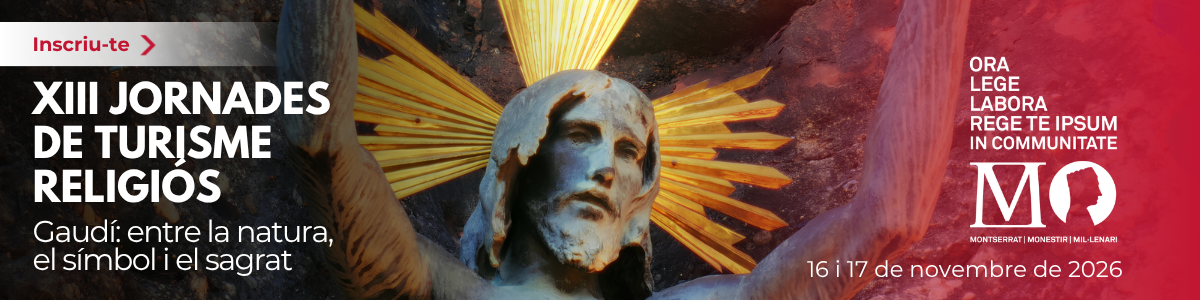
The motto Ora, Lege, Labora, Rege te ipsum, In Communitate can be read starting from its foundation to unravel the values it contains, all the way to reaching the summit, which is none other than God.
Prayer
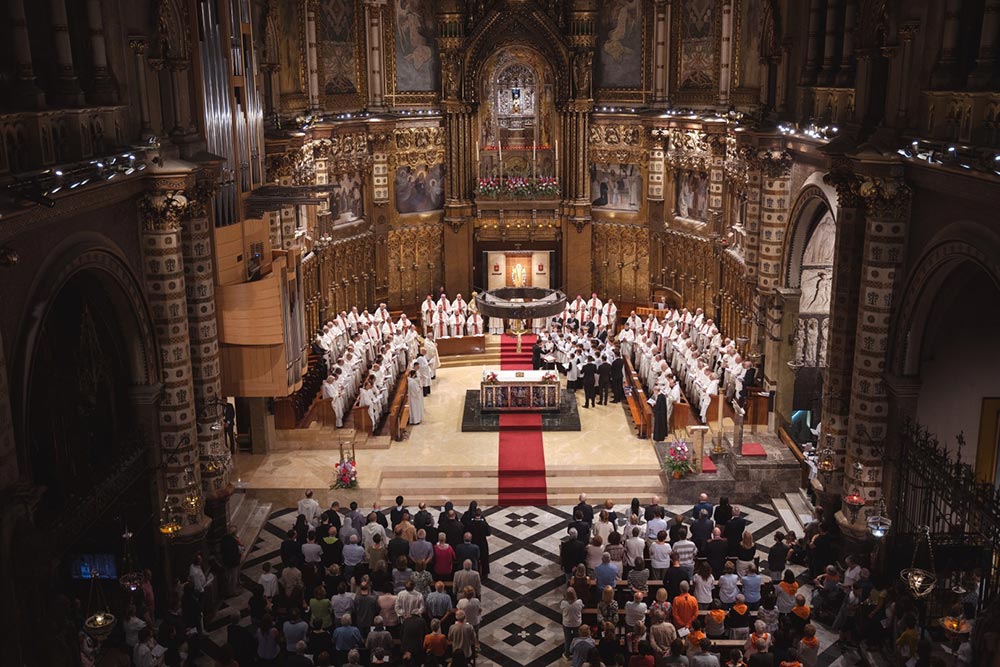
Prayer is the center of the monks' daily routine. Through the Divine Office and the conventual Mass, the community comes together to encounter God and one another. We pray to remember that life is greater than ourselves and to find meaning in what we do.