



The Violence of Love (October 25, 2026)
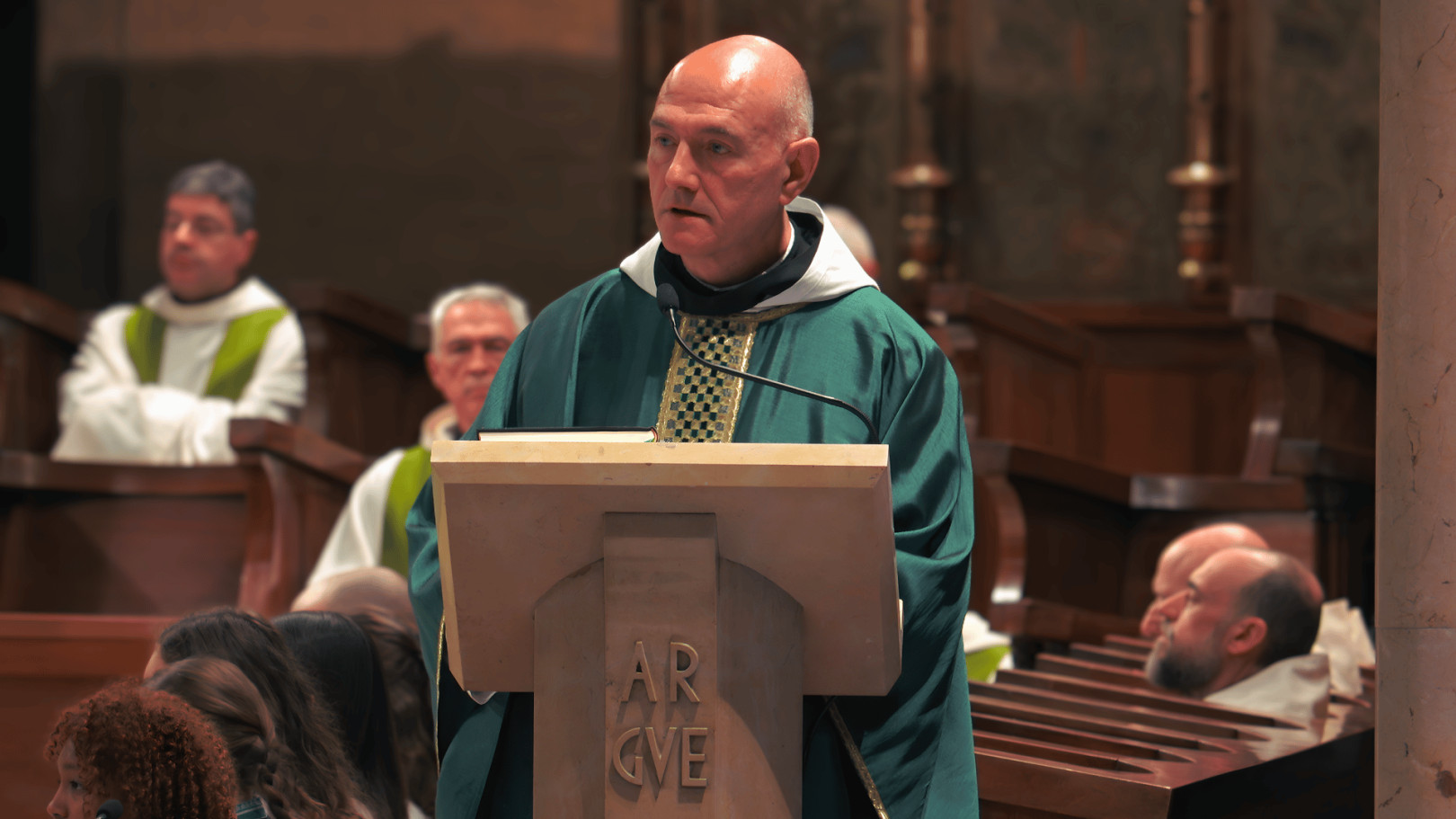
Homily by Fr. Joan M. Mayol, Monk of Montserrat - 30th Sunday in Ordinary Time (Year A)
26 October de 2026
Ex 22:20-26 / 1 Thess 1:5c-10 / Mt 22:34-40
When we look at the news and see how injustice, violence, and war seem to take an ever-greater hold on the world each day, perhaps we are merely witnessing the large-scale drama of that which also takes place within our own hearts.
It is relatively easy for us to judge the world and find solutions over a cup of coffee. Conversely, it costs us far more to recognize our own selfishness, to name our passions, and to admit the harm that some of our decisions can cause.
This is why the Word of God remains so uncomfortable. It does not offer us a superficial peace built on silence and complicity with injustice. It speaks to us of a fire that transforms and a sword that exposes the contradictions of the heart.It compels us to take a stand, for the Gospel does not allow us to take refuge in indifference or in a false neutrality before human suffering.
Today, this Word reminds us in a special way of the suffering of so many people who are forced to leave their homes and who, when knocking on our doors, do not always find welcome or fraternity.
The Word of God is resounding: "Do not mistreat or oppress the foreigner. Do not mistreat any widow or orphan...".These ancient words continue to challenge many of our present-day personal, social, and political attitudes. Far too often,private interests and collective fears prevent us from seeing the concrete faces of individuals and lead us to shirk our responsibility toward them.
It is true that our capabilities are limited. We cannot resolve every conflict nor alleviate all suffering. But faith in the love of God and neighbor, which Jesus proclaimed to us in the Gospel, impels us to work, each according to our means, for justice, peace, and freedom; to welcome, share, and defend the dignity of every person. A world different from the one we know today, marked by violence, is possible if we allow the Gospel to guide our decisions. And this transformation begins within ourselves.
It begins when we dare to examine the idols that have taken root in our lives: money, power, fame, appearances, or the constant need for recognition and admiration.
In our immediate surroundings, we are sometimes more concerned with achieving success, being popular, or gaining the approval of others than with living genuinely and loving truly. We exert so much effort trying to attain what makes us appear important that we end up forgetting what truly gives meaning to life: family, friendship, love, respect, and solidarity.
The problem is not the desire to progress or to have goals. The problem begins when we make these things the core of our existence and place them above God and our brothers and sisters. Then, that which was meant to be a means becomes an idol, and that which promised to make us happy ends up enslaving us.
Saint Paul reminded us in the second reading of this Mass that we turned to God from idols to serve the living and true God, while awaiting His Son Jesus from heaven, whom He raised from the dead. This hope does not distance us from the world nor relieve us of our responsibilities. On the contrary, it commits us even more deeply to the present, for our lives are called to bear fruit before God.
Therefore, love, mercy, solidarity, and forgiveness are not secondary values. They are concrete signs of a life transformed by the Gospel.
And this is where the most astonishing strength of the Christian message reveals itself.
As the testimony of so many saints reminds us, we cannot remain silent in the face of injustice. We must raise our voices,denounce evil, and work for a more just world without replicating the logic of violence. "We have never preached violence," affirmed the martyr bishop Óscar Romero. "We have never preached violence. Only the violence of love, that which left Christ nailed to a cross, that which each person exercises upon themselves to overcome their selfishness and so that there may be no such cruel inequalities among us" (Homily, November 27, 1977).
Brethren, through faith we are not asked to be able to do everything, but rather not to resign ourselves to doing nothing.We are not asked to save the world by our own strength, but to allow the love of Christ to work within us. This is the true force of love: a force that does not build walls, but opens doors; that does not humiliate, but dignifies; that does not destroy, but restores life anew.
Upon leaving this Eucharist, let us ask ourselves not only what ought to change in the world, but also what we are called to change within ourselves. For the world will not become more fraternal unless fraternity begins in our hearts, in our words, in our cultural and social commitments, in our political decisions, and also in the simplest, most everyday gestures of each day.
Our way of living, guided by the Gospel, must become—wherever we may be—a seed of peace, justice, and fraternity.For peace does not necessarily begin when conflicts disappear, but when we decide not to fuel them or be complicit in them. And fraternity does not begin when others change, but when we ourselves allow ourselves to be transformed by God's love and learn to live united as children of God.
May this love of God, received and shared, guide our steps and direct our decisions, so that wherever there is division, we may sow communion; wherever there is injustice, we may defend human dignity; and wherever all seems lost, we may keep hope alive.
Montserrat, October 25, 2026
Tags
Homilies Now on home page
16 july de 2026
26 october de 2026
El més llegit