




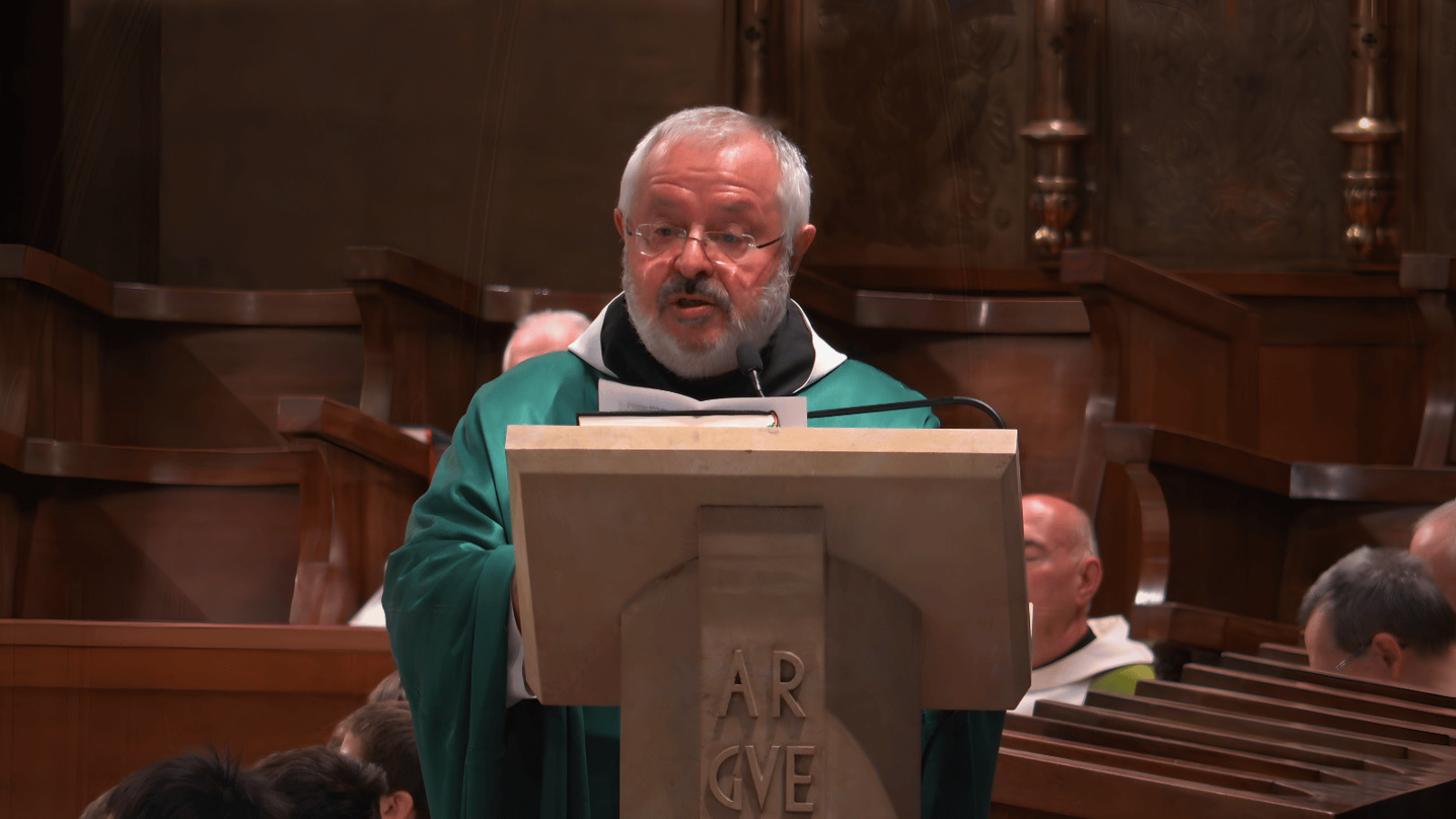
Homily by Fr. Lluís Juanós, monk of Montserrat (20 September 2026)
25th Sunday in Ordinary Time (Year A)
Abadía de Montserrat - EN
20 September de 2026
Isaiah 55:6–9 / Philippians 1:20–24, 27a / Matthew 20:1–16a
It seems this year is reluctant to say goodbye to summer and give way to autumn, where the forests dress in a thousand colors and the vineyards yield the fruits of the harvest. It was probably autumn in the Gospel account we have just heard as well, and in the villages of Galilee, the harvest was being lived intensely. In the squares, Jesus saw those who had no land of their own, waiting to be hired to earn their daily wage. And Jesus, a keen observer, told his disciples this parable that we have just heard. It is certainly a surprising parable, and listening to it, many of us may have had the exact same reaction as those first-hour workers: Why does everyone get the same wage, whether they worked all day or only for a single hour? That doesn't seem fair. Obviously, the Gospel is not an economic productivity manual. If vineyard owners acted like the one in the parable, they wouldn't find anyone willing to work from the first hour, and the business would go bankrupt. That is not where the message of the parable is heading.
If we look closely, we will see an owner who cares more about the workers than about his property. He wants everyone to have work, he doesn't want anyone to be idle, and he wants everyone to be able to earn the bread they eat. That is why he pays them all the same: the first ones because it was the agreed-upon wage, and the last ones to compensate for their time of waiting and abandonment. But the first-hour workers view work as a deserved right rather than a privilege. For them, labor has turned into a heavy burden: "we have had to bear the whole weight of the day," forgetting the hardship of being unemployed, of finding no one to give you a job. They resent the owner being generous with others and cannot rejoice in a blessing that isn't theirs. It is worth noting how similar this reaction is to that of the older son in that other parable, where the father warmly welcomes back the younger son, lost and found again. The last-hour workers, on the other hand, no longer expected to find work; they had already given up hope after a wasted day and had no standing anywhere to claim anything... And suddenly, someone hires them when there is only one hour left until sunset! After that brief hour of work, they go to collect their pay and receive the exact same wage as the others, as if they had worked the entire day!
What is Jesus telling us through this parable? Here, Jesus is speaking to us about salvation. Jesus wants to answer the Pharisees and scribes who criticize him for coming to save sinners. Is it fair to treat the last the same as the first? The former have faithfully observed the Law all along, while the latter, converted at the last minute, have very little merit to show. But God's thoughts do not align with human calculations. The reaction of the first hired hands proves it, as we have seen. Thus, the last will be first, and the first will be last.
Jesus wants us to grasp something fundamental that we often forget: God saves us not because we deserve it, but because He is good and generous. I do not "buy" my salvation. I do not "pay" for it with my merits. Salvation is a free gift from God that bears no proportion to my merits. God is not driven by criteria of strict justice; He is moved by love, by pure goodness. Christian salvation does not depend on how long we have been working, nor on our many or few good deeds, but on the unconditional love of a God who loves people far more than their deeds. Good works are a consequence of salvation, not its cause: a Christian strives to do good because they have been saved, not to see if doing so will get them saved. And that is the difference.
Those who follow the Law and do what is expected to earn salvation will receive a salvation proportional to the Law; they will get the exact measure of what they agreed upon. They themselves have set the price and the reward. God will strictly fulfill His part—not a single penny less, but not a penny more either. In contrast, those who open themselves to God's generosity, no matter what hour it is, will receive beyond all measure and experience immeasurable joy. They will share in the very joy of God, who rejoices more over one sinner who repents than over ninety-nine righteous people who need no repentance. Salvation, you see, is a single daily wage: one denarius. You either accept it or refuse it, but it cannot be divided into fractions; you cannot reduce to measures what is beyond all measure.
Is God unfair, then? Depending on how you look at it, yes, He is... He is unfair by excess, not by default. The conflict does not arise because God was unfair to the first-hour workers, but because He was "too generous" with the last. And unless we discover the wonder of this "unjust justice" called Love, we won't understand a thing; we will be like that Pharisee flaunting his merits before God, while Jesus praised the tax collector who, kneeling in a corner of the temple, had nothing to offer and only asked for God to have mercy on him. The parable is so revolutionary that we probably still don't dare take it seriously. Could it really be true that God is good even if we only recently felt called by Him and have few merits and works to present? Could it really be true that in His Fatherly heart there are no privileges based on the more or less meritorious work of those of us who may have been working in His vineyard for years?
Brothers and sisters, whether we feel like first-hour or last-hour workers, whether we are close to or distant from the Church, God invites us all into His vineyard. He calls us to overcome any lingering resentment, knowing that His Love surpasses our calculations and His grace offers us far more than we could ever deserve.
It seems this year is reluctant to say goodbye to summer and give way to autumn, where the forests dress in a thousand colors and the vineyards yield the fruits of the harvest. It was probably autumn in the Gospel account we have just heard as well, and in the villages of Galilee, the harvest was being lived intensely. In the squares, Jesus saw those who had no land of their own, waiting to be hired to earn their daily wage. And Jesus, a keen observer, told his disciples this parable that we have just heard. It is certainly a surprising parable, and listening to it, many of us may have had the exact same reaction as those first-hour workers: Why does everyone get the same wage, whether they worked all day or only for a single hour? That doesn't seem fair. Obviously, the Gospel is not an economic productivity manual. If vineyard owners acted like the one in the parable, they wouldn't find anyone willing to work from the first hour, and the business would go bankrupt. That is not where the message of the parable is heading.
If we look closely, we will see an owner who cares more about the workers than about his property. He wants everyone to have work, he doesn't want anyone to be idle, and he wants everyone to be able to earn the bread they eat. That is why he pays them all the same: the first ones because it was the agreed-upon wage, and the last ones to compensate for their time of waiting and abandonment. But the first-hour workers view work as a deserved right rather than a privilege. For them, labor has turned into a heavy burden: "we have had to bear the whole weight of the day," forgetting the hardship of being unemployed, of finding no one to give you a job. They resent the owner being generous with others and cannot rejoice in a blessing that isn't theirs. It is worth noting how similar this reaction is to that of the older son in that other parable, where the father warmly welcomes back the younger son, lost and found again. The last-hour workers, on the other hand, no longer expected to find work; they had already given up hope after a wasted day and had no standing anywhere to claim anything... And suddenly, someone hires them when there is only one hour left until sunset! After that brief hour of work, they go to collect their pay and receive the exact same wage as the others, as if they had worked the entire day!
What is Jesus telling us through this parable? Here, Jesus is speaking to us about salvation. Jesus wants to answer the Pharisees and scribes who criticize him for coming to save sinners. Is it fair to treat the last the same as the first? The former have faithfully observed the Law all along, while the latter, converted at the last minute, have very little merit to show. But God's thoughts do not align with human calculations. The reaction of the first hired hands proves it, as we have seen. Thus, the last will be first, and the first will be last.
Jesus wants us to grasp something fundamental that we often forget: God saves us not because we deserve it, but because He is good and generous. I do not "buy" my salvation. I do not "pay" for it with my merits. Salvation is a free gift from God that bears no proportion to my merits. God is not driven by criteria of strict justice; He is moved by love, by pure goodness. Christian salvation does not depend on how long we have been working, nor on our many or few good deeds, but on the unconditional love of a God who loves people far more than their deeds. Good works are a consequence of salvation, not its cause: a Christian strives to do good because they have been saved, not to see if doing so will get them saved. And that is the difference.
Those who follow the Law and do what is expected to earn salvation will receive a salvation proportional to the Law; they will get the exact measure of what they agreed upon. They themselves have set the price and the reward. God will strictly fulfill His part—not a single penny less, but not a penny more either. In contrast, those who open themselves to God's generosity, no matter what hour it is, will receive beyond all measure and experience immeasurable joy. They will share in the very joy of God, who rejoices more over one sinner who repents than over ninety-nine righteous people who need no repentance. Salvation, you see, is a single daily wage: one denarius. You either accept it or refuse it, but it cannot be divided into fractions; you cannot reduce to measures what is beyond all measure.
Is God unfair, then? Depending on how you look at it, yes, He is... He is unfair by excess, not by default. The conflict does not arise because God was unfair to the first-hour workers, but because He was "too generous" with the last. And unless we discover the wonder of this "unjust justice" called Love, we won't understand a thing; we will be like that Pharisee flaunting his merits before God, while Jesus praised the tax collector who, kneeling in a corner of the temple, had nothing to offer and only asked for God to have mercy on him. The parable is so revolutionary that we probably still don't dare take it seriously. Could it really be true that God is good even if we only recently felt called by Him and have few merits and works to present? Could it really be true that in His Fatherly heart there are no privileges based on the more or less meritorious work of those of us who may have been working in His vineyard for years?
Brothers and sisters, whether we feel like first-hour or last-hour workers, whether we are close to or distant from the Church, God invites us all into His vineyard. He calls us to overcome any lingering resentment, knowing that His Love surpasses our calculations and His grace offers us far more than we could ever deserve.
Tags
Homilies Now on home page
8 october de 2026
16 july de 2026
5 october de 2026
El més llegit